....
....
|
..
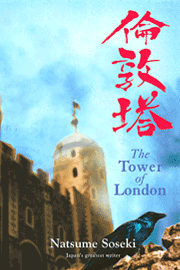
The
Tower of London
Natsume
Soseki
Translated
and introduced by Damian
Flanagan
Published
by Peter
Owen
Click here for an
introduction to the book.
(Transcript
from BBC radio.)
‘The
curtain veiling the mysterious things called the past rending itself in
two and reflecting ghostly light over the twentieth century is the
Tower of London.’
In
October
1900, a brilliant but largely unknown Japanese scholar arrived in
London to commence two years of intense study. The scholar would later
become the most celebrated Japanese writer of all time, Natsume Soseki,
and produce a dazzling collection of novels, memoirs, criticism and
short stories that form the bedrock of modern Japanese literature.
The
spectacle of a Japanese visitor to Victorian London was a rare one, and
Soseki’s acute observations contain unique snapshots of
London life.
(Click
here for an excerpt from
the book: 'Lodgings'.)
Against
the
backdrop of these images, Soseki develops profound reflections on
universal themes. The river Thames is transformed into the river Styx;
the Tower of London becomes a gateway to the Underworld; mysterious
boarding houses and the spirits of the dead are encountered through
relics and memoir; time itself is regained and explored.
This
new
translation provides the perfect introduction to the work of one of the
world’s greatest authors, accompanied for the first time with
a comprehensive critical introduction, and a wry fictional account of a
meeting between Soseki and Sherlock Holmes.
Click here for Damian
Flanagan's speech at the book's
launch.
The
speech is not only a thorough introduction to the book, but also
explains the background of its publication whilst contextualising
Natsume Soseki in the annals of world literature.
‘We
know little about the literary baggage that informs Japanese
preconceptions of Britain. It’s rather a shock to discover
that the most familiar and most compelling is a vision of Victorian
London at the turn of the 20th century by a young Japanese scholar, one
of Japan’s most famous modern writers, who lived for two
years in boarding houses and met almost no one. The Dickensian London
he brilliantly describes is so close to virtual reality that in one
short story Soseki himself meets Sherlock Holmes.’
– The Times
‘Scrupulously
and enthusiastically introduced and annotated’ –
Anthony Thwaite, Sunday
Telegraph
'What makes
this collection so fascinating is that Soseki viewed England as much
from the viewpoint of an anthropologist as from that of a creative
writer . . . one is never in doubt that one is in the presence of
greatness. The translator, Damian Flanagan, has provided an excellent
introduction and ample notes. I have always thought that of all English
novelists it is E. M. Forster that Soseki most resembles. Flanagan,
whether deliberately or not, catches Forster’s authorial tone
with uncanny accuracy.'
– Spectator
Available
through Amazon.co.uk |
|
|
Top of page |
|
....
....
|
..
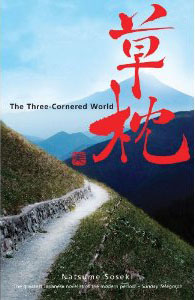
The
Three Cornered World
Natsume
Soseki
Translated
by Alan Turney
Introduced
by Damian
Flanagan
Published
by Peter
Owen
Opening
with the most famous introductory lines in Japanese
literature, The
Three Cornered World has been cherished by generations of readers as a
glittering jewel in the crown of Soseki s artistic
achievement.
A
painter escapes to a mountain spa to work in a world free of emotional
entanglement, but finds himself fascinated by the alluring mistress at
his inn and, inspired by thoughts of Millais Ophelia, he imagines
painting her. The woman is rumoured to have abandoned her husband and
fallen in love with a priest at a nearby temple, but somehow the right
expression for the face on her painting eludes the artist . .
.
Beautifully
written, humorous and filled with bitter-sweet reflections on the human
condition, The Three Cornered World was intended as a unique
haiku-novel with a mood utterly different to anything ever produced in
the West. Demonstrating along the way a mastery of everything from
Western painting to Chinese literature, Soseki succeeded in an artistic
tour-de-force that produced what legendary recording artist Glenn Gould
would simply refer to as his favourite book.
Vastly
refreshing . . . Soseki doesn t shrink from seeking and finding
exquisite pearls of beauty. --Guardian
A
writer to be judged by the highest standards. His works create, after
the fashion of all great writers, a new and completely individual
reality. --Spectator
The
greatest Japanese novelist of the modern period --Sunday Telegraph
A
writer to be judged by the highest standards. His works create, after
the fashion of all great writers, a new and completely individual
reality. --Spectator
The
greatest Japanese novelist of the modern period --Sunday Telegraph
Available
through Amazon.co.uk
|
|
|
Top of page |
|
 |
..
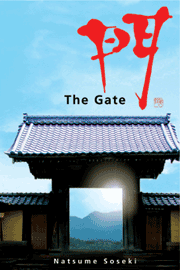
The Gate
Natsume
Soseki
Translated
by Francis Mathy
With
a new introduction by Damian
Flanagan
Published
by Peter
Owen
One
of the central masterpieces of twentieth-century Japanese literature, The Gate
describes
the everyday world of the humble clerk Sosuke and
his wife Oyone, living in quiet obscurity in a house at the bottom of a
cliff.
Seemingly
cursed with the inability to have children, the couple find themselves
having to take responsibility
for Sosuke’s younger brother Koroku. Oyone’s health
begins to fail, and news that Oyone’s estranged ex-husband
Yasui will be visiting nearby finally promotes a sense of crisis in
Sosuke and forces him temporarily to quit his life of quiet
domesticity.
Highly
prized for the beauty of its description of the understated love
between Sosuke and Oyone, the novel has nevertheless remained in many
ways mysterious. An analysis of the novel here by Dr Damian Flanagan
casts fresh insights into its complex symbolism and ideas, establishing
The Gate
as one of the most profound works of the modern age.
The
Gate (previously published as Mon)
follows
the publication of an important new translation of Soseki’s The
Tower
of London.
Published
in cooperation with the Japan Foundation and the Sasakawa Foundation,
it is part of an international programme to bring one of
Japan’s most popular author to a new international audience.
A
sensitive, skilfully written novel by the most widely read Japanese
author of modern times.’ – Guardian
Soseki’s
prose is so delicate that each page is like looking at a set of dreamy
watercolours.’
– Sunday
Telegraph
‘The
Gate is not so much tragic or comic as a graceful balance
between the
dispiriting and the humorous . . . The
Gate is surely the kind of
writing we need – a masterpiece of taste and clarity. Francis
Mathy’s translation must be warmly commended.’
– New
Statesman
Available
through Amazon.co.uk
|
|
|
Top of page |
|
 |
..
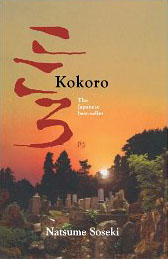
Kokoro
Natsume
Soseki
Translated
by Edwin McClellan
With
a new introduction by Damian
Flanagan
Published
by Peter
Owen
Damian
Flanagan says in his new critical introduction "Kokoro" is the Soseki
novel that has been given most attention by critics and the public in
Japan. On one level, a meditation on the changing face of Japanese
culture and its attitudes to honour, friendship, love, death, it is
also a sly subversion of all of these things.
The novel centres around
the friendship between the narrator and the man he calls Sensei, who is
haunted by mysterious events in his past. As the friendship grows and
the narrator gets to know more about the man he so admires he is
increasingly intrigued by this hidden history. The Sensei, however,
refuses to reveal anything until the third part of the book when the
narrator is called away to look after his sick father and the truth is
revealed in tragic circumstances, etching itself onto the narrator -
and the reader's - "Kokoro" : Heart.
Natsume Soseki's importance to Japanese literature can be compared to
that of Dickens to Britain or Henry James to America. Like these
writers, his work now holds a hugely popular and important place in the
literary imagination of his country. Unlike them, his work is only
recently coming to the attention of readers from overseas.
Available
through Amazon.co.uk
|
|
|
Top of page |
|
...
...
|
..
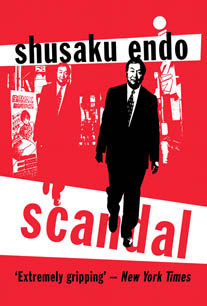
Scandal
Shusaku
Endo
Translated
from the Japanese by Van C. Gessel
Published
by Peter Owen
Suguro
is an eminent Catholic novelist, about to receive a major literary
award. So when a drunk woman he has never met before approaches him at
the award ceremony, claiming she knows him well from his regular visits
to Tokyo’s red-light district, she must surely be mistaken?
But
with a scurrilous press campaign damaging Suguro’s
reputation,
his sleazy doppelg�nger appears more and more, as if
deliberately
trying to discredit him. He is sighted touring the love hotels and
brothels of Shinjuku; a leering portrait of him appears in an
exhibition — and Suguro is forced to undertake a journey into
Tokyo’s seedy heart in order to discover the dreadful truth.
Well
known for his novel Silence,
which is to be filmed by Martin Scorsese,
Endo here abandons his characteristic understated style in order to
write a dark metaphysical and psychological thriller that is reckoned
to be one of his best — and most original — works.
WITH
A NEW FOREWORD BY DAMIAN FLANAGAN
‘Endo’s
most remarkable novel . . . a superb dramatic triumph, a perfect
plaiting of strands into a single, most delicate crowned
knot.’
— Independent
‘A
remarkable work . . . Endo is one of the best novelists in the
world.’ — Francis King, Spectator
‘Endo
is a great thriller writer . . . Spine-chilling, erotic, cruel, full of
intellectual games . . . very powerful.’
— Sunday Telegraph
‘Scandal
is a subtle, eerie and fascinating book by a writer of rare perception
and disquieting honesty.’ — John Walsh, London
Evening
Standard
SHUSAKU
ENDO is widely regarded as one of the greatest Japanese authors of the
late twentieth century. Born in 1923, he won many major literary awards
and was nominated for the Nobel Prize several times. His novels, which
have been translated into twenty-eight languages, include The Sea and Poison, Wonderful Fool, Deep River and Silence. He died in
1996.
Available
through Amazon.co.uk
|
|
|
Top of page |
|
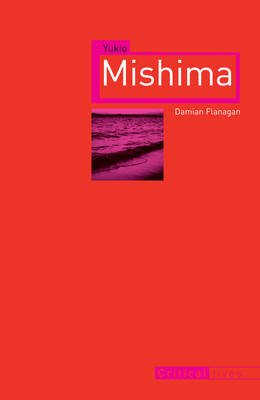 |
Mishima
Yukio Mishima
Damian Flanagan
In
1970 Yukio Mishima shocked the world with a bizarre
attempt
at a coup d’�tat, ending in his spectacular suicide by ritual
disembowelment. Why?
Mishima was
the most internationally acclaimed Japanese author of the twentieth
century: prodigiously talented, dazzlingly prolific and a prime
candidate for the Nobel Prize. In his radically new analysis of an
extraordinary life, Damian Flanagan moves away from
the stereotypical depiction of Mishima as
a right-wing nationalist and aesthete and presents him as a man utterly
obsessed with time, time-keeping devices and symbols, arguing that this
compulsion was at the heart of the author’s literature and life.
This
book untangles the frequent distortions in the writer’s memoirs, which
have often been taken at face value, and traces the evolution
of Mishima’s
attempts to master and transform both his sexuality and artistic
persona. Though often perceived as a solitary protest figure, this book
shows how Mishima was very much in tune with post-war
culture: taking up bodybuilding and becoming a model and actor in the
1950s; adopting the themes of contemporary political scandals in his
work; courting English translators and even becoming influenced by the
student protests and hippy subculture of the late 1960s.
Yet
while being in thrall to the modern world, the flip side
of Mishima’s personality – his hidden neuroses and the traumas
of
his youth – continually pushed him towards a firm rejection of modern
Japan and his explosive final act of self-annihilation.
Reaktion Books
Critical
Lives is a major series of short critical biographies that present the
work of important cultural figures in the context of their lives. Each
book relates and brings alive the life of the artist, writer,
philosopher or architect in question and assesses their major works at
the same time.
Also available through Amazon.co.uk |
Available
through
Waterstones |
|
|
|
 |
..
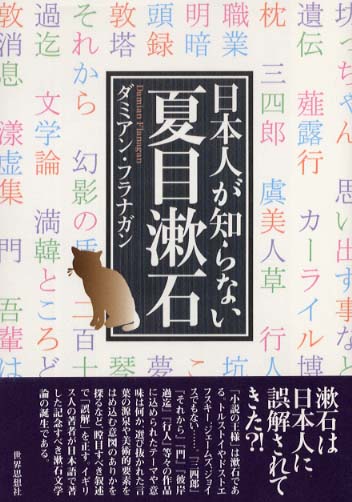
日
本人が知らない夏目漱石
(The
Natsume Soseki the Japanese Don't Know)
Has
Japan's greatest literary figure been misunderstood by the Japanese
themselves?!
In
this landmark study, Damian Flanagan provocatively argues that
the 'King of the Novel' is not Joyce or Proust, Tolstoy
or James, but none other than Natsume Soseki himself. By
investigating the themes of such classic novels as Sanshiro, And
Then, The
Gate, To
the Spring Equinox and Beyond
and The
Wayfarer,
and explaining how Soseki was fundamentally influenced by
figures as diverse as Nietzsche and the Pre-Raphaelites, an
entirely new understanding of Soseki's dazzling literary
career comes to light.
This book
is only available in Japanese.
Available
through Amazon.co.jp
|
|
|
Top of page |
|
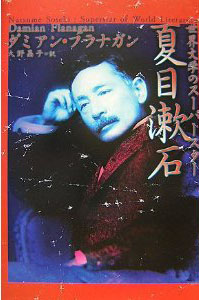 |
世界文学のスーパースター夏目漱石
(Natsume
Soseki: Superstar of World Literature)
Damian Flanagan
Translated
by Ono Akiko
Published by Kodansha International
Damian
Flanagan finds Japan's man of letters has a multitude of ideas relevant
to navigating the vissitudes of life in the modern world. This is a
self-help book with a difference - your tour guide is Natsume Soseki:
Superstar of World Literature.
Available
through Amazon.co.jp |
|
|
|
|
 |
..
Damian
is also the author of numerous articles and short pieces for magazines
and newspapers in the UK.
He
also written for The Japan Times, the Asahi
Shinbun and
Kyoto Journal in
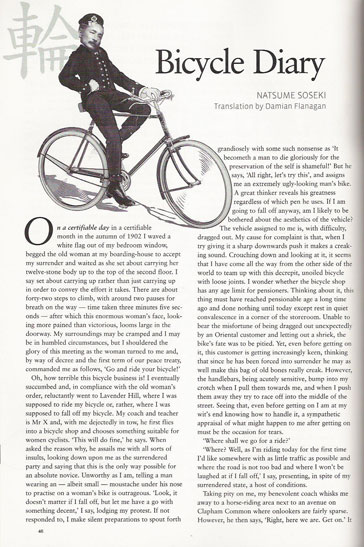
Japan. The image on the left is an excerpt from The
Tower of London commissioned
by the Kyoto Journal.
|
|
|
Top of page |
|
|